Showing posts with label beekeeping. Show all posts

Wednesday, April 10, 2019

God Save the Queen! Honey Bee update.


Earlier this week we did a full inspection in the bee yard.  All of our hives survived the winter. We have 4 full size hives and 3 nucs.


 All hives are looking great except the Hufflepuff. They are getting ready to overthrow their queen (supersede). About a week and half ago the hive was full of capped brood and larva, but when we check them yesterday there was no capped brood and only a few larva. We spotted the queen, so she is still there...but she's not doing her job. So they are attempting to raise a new queen to supersede her.

We have a few different options that we could do. We could cull the queen (kill her) and introduce a new queen, or let nature take it's course and hope that they are able to successfully raise a new queen on their own.

We decided to allow them to raise their own queen.  We gave them some frames of eggs and larvae from another hive, and are hoping for the best.  This photo is a supercedure cell, and it's where they will raise their queen. Once the queen hatches, she'll most likely kill the old queen and go on a maiden mating flight to seek out drones from a different hive to mate with.  She will then return to lay eggs and act as the ruling queen.  It's all a little risky, but we are hoping it all works out other wise we could lose this hive.


 All other hives look good, we'll be doing some splits soon to hopefully prevent swarming. The bees are bringing in all kinds of different colored pollen. Red, orange, yellow and green!


They love the Dead nettle, this guy is covered in pollen.


i had no idea there were so many different colors of pollen.   You can see red, orange, yellow and green in the hive! 

i found this chart online to help identify some of the pollen colors. Right now our peach trees are in full bloom, but the bees can travel up to 2 miles radius looking for pollen. So i'm not sure what all they are bringing in.

We are hoping to pull honey after the next big honey flow. A bit disappointed that we probably won't be getting any from Hufflepuff while they are busy trying to raise a new queen instead of focusing on honey production.  i'm just really hoping that the new queen survives and can save the hive before it's too late. God save the queen!

Wednesday, March 13, 2019

Honey, it's warming up outside!

i wouldn't say that winter is officially over, but we have been getting a few really nice days in between the crappy one.  On those days when it's over 60, we check on the bees.


We've been eager to check them all winter, but it has to be over 50 degrees outside to open the hive.  So we've had to patiently wait and hope for the best. It's not unusual to lose a few hives over the winter. We started the winter with 4 main hives (2 deeps, 2 regular) and 3 nucs. We had try to go into winter with 4 hives and 4 nucs, but one of our splits refused to accept a new queen and we eventually had to combined it back with it's regular hive.


When the temperatures are warm enough for the bees to fly, we know it's safe to do an inspection of the hive.  There isn't much pollen available yet, but the bees leave the hive to poop and clean out any dead bees that didn't survive the winter.


Inspection went well!  All of our hives survived the winter and appear to be thriving. We found all the queens and spotted new larvae and capped brood in all hives and nucs!!   The bees still have plenty of stores to get them into to the next honey flow.  So we should be able to pull a lot of honey this spring.


In the Spring, we have to watch for signs that the bees may swarm. We have two extra nuc boxes available if we need to split. We also have two queen castles and will attempt to raise our own queens.


Just this week i've started to see a few things blooming.  The bees are beginning to bring in some pollen from their daily flights.  Dandelions are the first spring food for bees..  As more things begin to bloom they should begin filling frames with pollen and nectar.  We are entering our second season with bees. It's has been a learning process for sure, but i'm really eager to see how they do this year.  i've been exploring lots of different recipes and uses for honey, and can't wait for our first honey harvest. We do plan to have some for sale in our Shady Grove Homestead store later this summer.

Tuesday, July 3, 2018

Bee inspection- replacing a queen and starting a nuc colony

About 2 weeks ago, we did a bee inspection and noticed that the bees in hive 2 (Slytherin) were bearding on the front of the hive and sounded really agitated. Sometimes they do this if it's really hot inside the hive, but once we opened up the hive we realized something else was going on. 


Once we started the inspection we understood why they were so agitated. We didn't find any eggs or larvae, which means their queen was most likely dead. 


This spotty broad pattern is another sign that things in the hive are not okay. Sometimes an unusual broad pattern can indicates a bad queen, but in our case it indicated that their was no queen. 


We checked all frames, but could not locate a queen, but we did find what we believe to be an emergency queen cell. We could have left the emergency queen cell and allowed the bees to raise a new queen, however we decided to move the queen cell into a 5 frame nucleus hive and requeen hive 2 with a local queen we were able to get from the bee association. This way they would have a new queen right away and be able to get back to maintaining the hive much quicker.


The new queen was introduced in a special queen cage (to keep the hive from killing her) and within a few days they had released and accepted her.  She is a marked queen and much easier to find than the unmarked ones. This week we'll be finding and marking all our queens. 


The emergency queen cell was moved to a nucleus hive with some frames of brood, larvae and worker bees. We are hoping to establish a nuc colony.  


Kenan has been building and painting more nuc boxes so that we can create more nucs. 'The term “nuc” is short for nucleus colony. A nucleus colony is just a very small colony of a few thousand bees and a queen. Reasons for maintaining a nuc: If one of your hives goes queenless, you have another queen ready to go. If you wait for your colony to re-queen itself, the population will drop such that you won’t get any surplus honey for that year. You can re-queen at times of the year when queens are unavailable to purchase. You can use the bees in a nuc to boost populations of a weak hive. If you don’t want to re-queen, you can just transfer some of the frames from your nuc into the weak hive. In addition, having an empty nuc box on hand is useful for catching swarms or removing extra bees from an overcrowded colony.' info taken from https://honeybeesuite.com 

We are hoping to start raising our own queens and have several nucs on hand. We'll be able to sell these or keep them to create more hives.  This has been such a good learning experience and we are constantly learning! Hoping we'll be able to pull a little honey this year, although you don't typically get a lot the first year. This year is more about learning, growing  and maintaining our hives.

We'll be doing another inspection in about a week and i'm hoping to have nothing but good news to report!

Friday, May 11, 2018

Our First Bee Hive Inspection

We performed our first inspection of the new hives this week. It was a little bit nerve racking, as we were hoping for the best, but not sure what we would find.   It has been almost 2 weeks since we installed the bee packages. Installation went okay, but we had a problem with one of the top feeders and were concerned with that hive especially. We didn't know if all the queens had been released or if they had been accepted. Sometimes the hive will kill the queen in those first days.


We were super pleased to find a lot of new drawn out comb in all of the hives. We have been feeding the bees syrup and pollen patties and it appears to be working for them. It was really pretty cool they way we could check the frames and only a bees were buzzing around, most just seemed focused on their tasks and ignored us. 


We were able to find all 4 queens! They are busy laying eggs and seem to have no problems being accepted by the hive.  Can you find the queen? She's right in the center of the photo. She has the long skinny body. She is depositing her eggs in each of the cells.


We also lots of comb filled with glistening nectar and pollen. We saw larvae, and eggs in every hive! The first two are larger hives and seem to be behind a bit, i think because they work harder in the larger hive. The two smaller hives are almost filled up already. Larva and eggs are really important to see, because in a couple of weeks all of the worker bees will die and (hopefully) be replaced with the new brood. The worker bees only live 5-6 weeks during an active season. So if there isn't eggs and larva, in a few weeks time the entire colony will collapse.  


We found capped brood (baby bees) in the 2 smaller hives.  Very excited to see that things are going so well so far!!!!! We were really worried about the first hive that had the problem with the top feeder, but it looks like they have recovered well and are doing great! So far no one has gotten stung! 

Kenan has set up an electric fence to hopefully deter the bears that have become common visitors on our land. They are the biggest threat to hives right now. We'll be doing another inspection this evening and we'll be adding  brood boxes on the smaller 8 frame / medium box hives. We are pretty optimistic that we may get a little bit of honey this first year, which isn't always a guarantee. Looking forward to our hive inspection this afternoon, we are waiting for the kids to get home from school so they can participate. This has been a fun learning experience for the whole family.  In just the two weeks we've had our hives, i've learned so much about bees i didn't know.

Friday, April 27, 2018

Adventures in Beekeeping. We have bees!

We've been anticipating this day for quite a while, but we finally got our bees! The weather has not been cooperating, and so the date kept getting pushed back. This has been the coldest April we've ever experienced here. With snow showers several times the first 2 weeks.  All the flowers are about 2 weeks behind, so that pushed everything back two weeks. 


Kenan is both excited and nervous. Beekeeping is a pretty large investment, and the strange weather has made it feel like a bit of a gamble. Last year many very experienced beekeepers lost almost all of their hives. For first time bee keepers it's not unusual to lose a hive a two the first year. If the weather isn't cooperating the loss could be even higher. 


To keep the bees passive they've been sprayed with a sugar syrup solution. They are so busy sucking up the sweet treat, they become docile and kind of 'sugar drunk'  and so they don't attack.


When it warmed up we added our bees to the hive. Bee behavior is affected by temperature. They rarely work when the temperature is below 57 F or above 100 F. They cannot fly when the temperature is below 55 F.   So we wanted to wait until it was warmer to add the bees. First thing is to remove the feed can. 


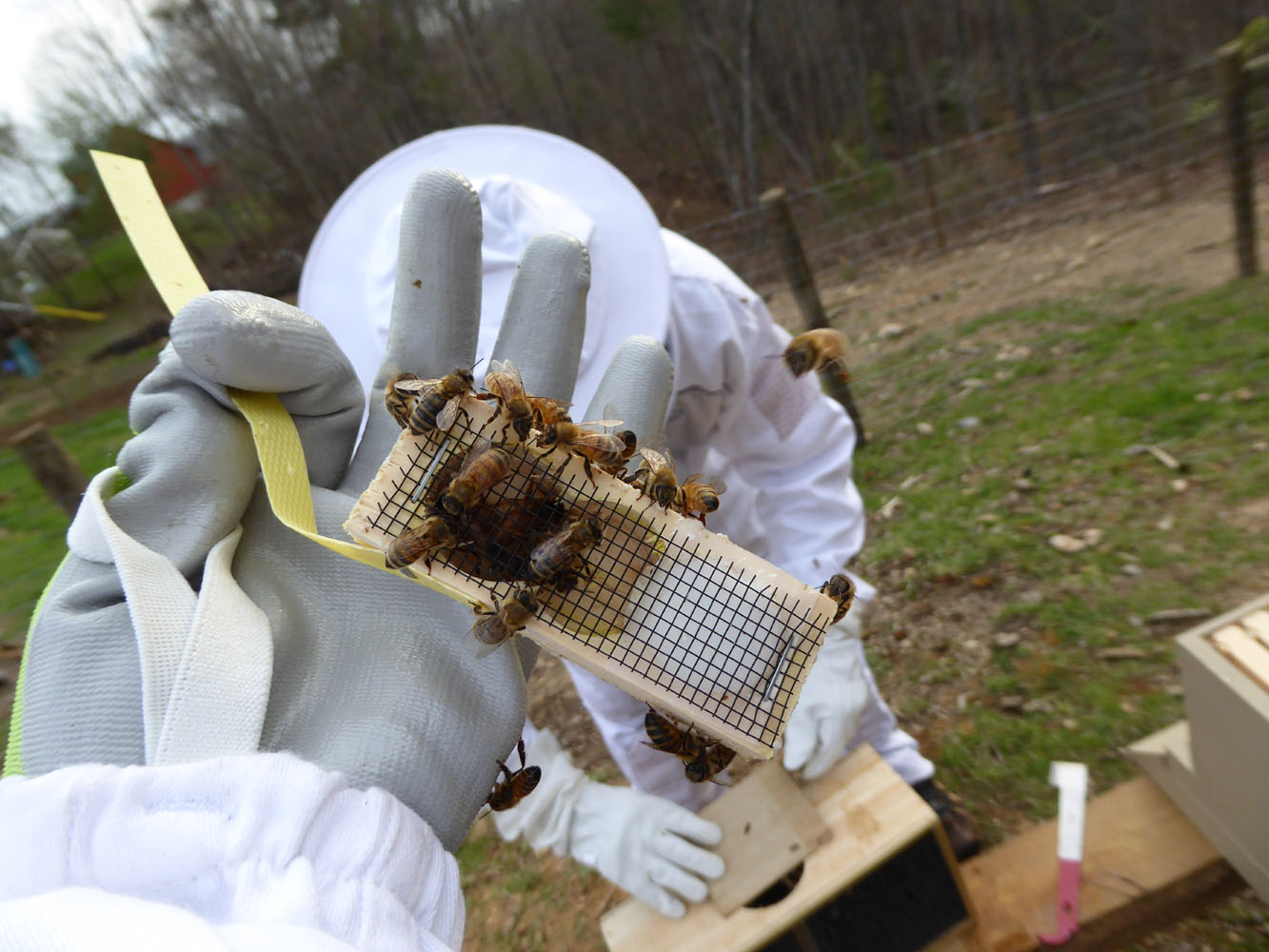
Next you remove the queen cage and make sure she's alive. The queen has to be separated from the hive until they get use to her and accept her scent. There is a 'candy' plug at one end of the queen box. It should only take the worker bees a couple days to eat through the plug and release the queen. 


Once the feeder can has been removed and the queen is set aside you remove a few frames from the center of the hive and literally dump the bees in. Once the bees are in the box you replace the frames and place the queen box on top of them. Then you close up the hive box and hope the bees release and accept her. We checked our queen cages after 2 days and 3 out of the 4 queens had been released (we have 4 hives). So today we'll check the remaining queen to make sure she is out. If not, we'll have to remove the plug and manually release her and hope that she is accepted into the hive. 


We had a few hiccups with the top bar feeders we used in two of the hives, and switched to canning jar feeders.  It looks like all four hives are doing well now though We had a couple days of cool wet weather right after we installed them, but yesterday it finally warmed up and they were flying in and out and very active.


We may or may not get any honey the first year. It's all a learning process at this point, and we are really just hoping our bees survive. We hope to see an increase in the pollination our gardens and fruit trees and eventually we look forward to harvesting honey, pollen and honeycomb. 

We purchased our bee boxes from Brushy Mountain Bee Farm and our bee suits from Humble Bee US.  The bees were ordered through the local bee association.  If you are interested in keeping bees i would recommend taking a bee class and connecting with your local bee association. Although raising bees isn't difficult, there is a lot of information to learn. It's definitely the kind of thing you want to research before jumping into it. We'll be sharing our beekeeping journey on the blog, as well as the many other projects we have going on this year.