Showing posts with label caterpillars. Show all posts

Wednesday, October 9, 2013

Caterpillars.

Earlier this year i was feeling a bit disappointed by the lack of monarch butterflies. Every year we walk along our road and rescue the monarch caterpillars before the county mowers come by and cut down all the milkweed. We have been doing this for years and really enjoy it.  With all the change we have experienced this year i've been kind of clinging to our past routines, and raising monarchs in the fall is one that we were always look forward to.

We found it odd that we were not seeing any monarchs this summer. We walked up and down the road, and checked all of the milkweed but we didn't find any caterpillars or eggs. Then the last time we walked up the road all of the milkweed had been cut down, so we knew we would not be seeing any monarch caterpillars this year.  Milkweed is their only food source.


Despite the lack of monarch caterpillars, we've been finding lots of other neat caterpillars! Many that we have never seen before here. This is a Black and orange oak worm.  My daughter is fearless, she holds all of them..even the ones i'm to squeamish to touch.


This one is a Blinded Sphinx moth caterpillar. He's a strange looking fella in the photo, but he was really a pretty caterpillar. Bright green with some reddish pink speckles. 


We found 6 Black Swallowtail caterpillars munching on our carrots.


This is an Eastern Tiger Swallowtail Caterpillar.  We found him near the mailbox. Yellow Poplar is a food source for the Eastern Tiger Swallowtails and there is a large tree near the mailbox, so we think he fell out.  i wanted to keep him so we could watch him pupate, but it didn't seem to want to eat any of the fresh  leaves i'd given him. So we decided to just put him back in a poplar tree.
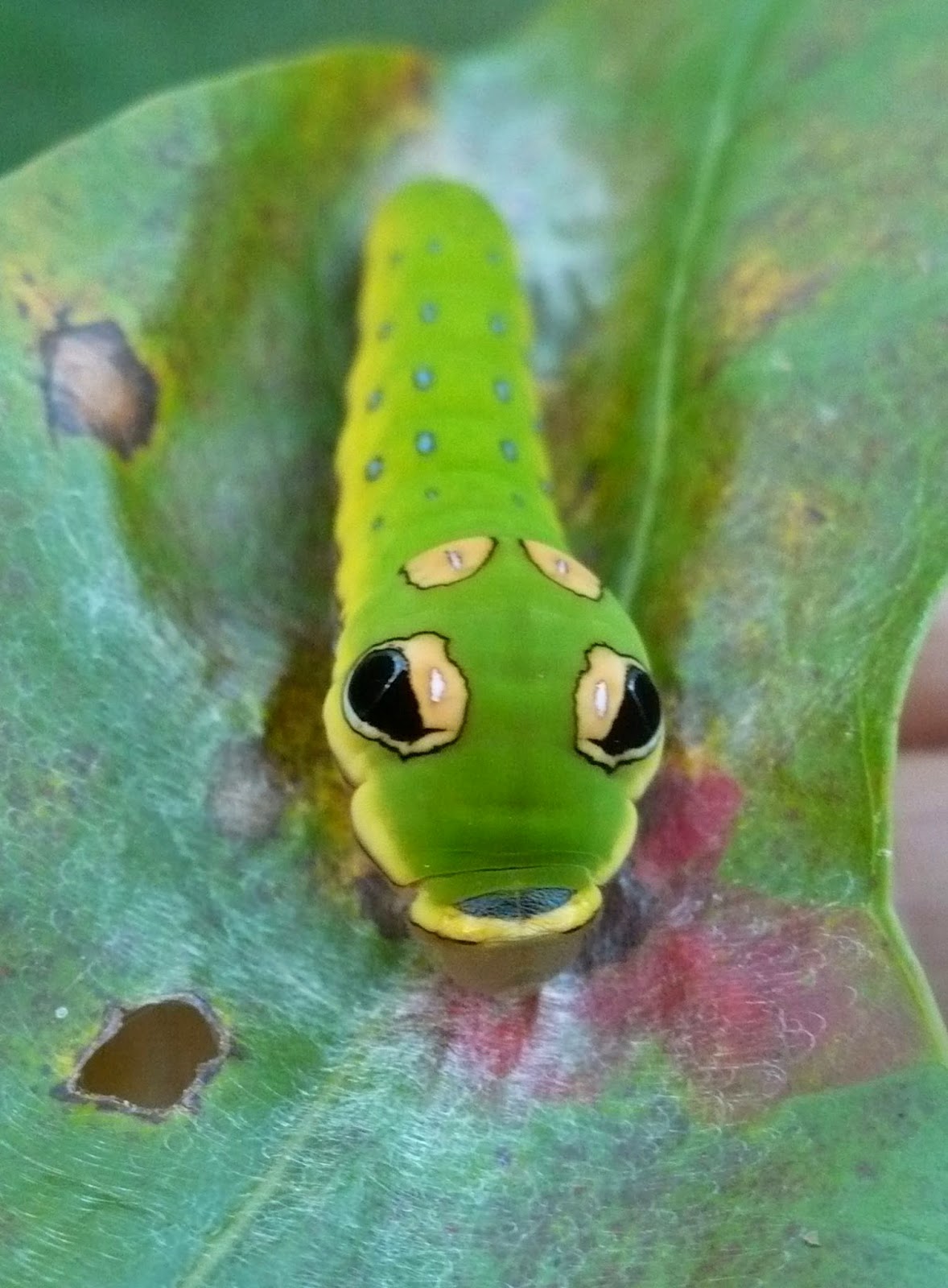


When i went to put the Eastern Tiger Swallowtail back on a poplar tree, i found this guy sitting quietly on a  Sassafrass tree. It's a Spicebush swallowtail caterpillar.  


This guy is the prettiest caterpillar i've seen in a while. Those giant eye spots are not really eyes at all. They are spots on his back that give him the appearance of a snake if a predator gets too close. He will tuck his head under, and puff up his back to show off those big 'eyes'.


The Spicebush caterpillar changes color right before he's going to pupate. So we collected the branch he was on, and are keeping it in our makeshift caterpillar habitat with the black swallowtail caterpillars. Hopefully we'll get to observe some pupating caterpillars soon. These caterpillars will stay in their chrysalis all winter, and they will not emerge as until spring.

i have always loved caterpillars and the process of metamorphosis, but never have i felt as connected as i do this year.  i am eagerly awaiting my time to pupate, and emerge next spring new and whole again.


 "We delight in the beauty of the butterfly, but rarely admit the changes it has gone through to achieve that beauty."- Maya Angelou


Friday, September 20, 2013

Raising Black Swallowtail Caterpillars.


One of our favorite activities each summer is to raise monarch caterpillars into butterflies. Near the end of July we begin taking weekly walks down the road checking the milkweed plants for monarch eggs and caterpillars.  This year we were surprised by the lack of monarchs. We have seen very few monarch butterflies in our flowerbeds. Walking down the road we realized there was very little milkweed this year, and no caterpillars. We checked several times and the last time we walked we found that the county mowers had come through and cut down all the milkweed. So we figured we would not be raising any caterpillars this year, the first time in probably 7 or 8 years.


Then one day last week, i was delighted to find a Black swallowtail caterpillar munching on my carrots. i plant dill and fennel every year because it is supposed to be a Black swallowtail favorite, but i haven't attracted any Black Swallowtails to it yet.  i was not expecting to find one in my carrots, and after looking around i found 5 others.  So i began to photograph them in the different stages. Black swallowtails go through several stages or instars, where they shed their skin and change their look a little.   This first one is about 1/2 " long. It is in the first Instar. 


After shedding it's skin the first time it enters the second instar. 


This one is about 1" long. He's a bit more colorful than the one before. 


During the Third Instar the caterpillarstarts getting quite a bit larger. He looks almost like a full sized BS caterpillar, except he is rather pale.The full grown caterpillars are green with the same markings.


This guy is full grown. He is resting, and will soon wander off to find a suitable place to form his chrysalis. i had originally left these guys on the carrot plants and have been checking them regularly. We really don't have a good place to keep them inside. Yesterday i noticed that a mole had started to nibble some of the carrots and the plants were wilting with the caterpillars still on them. So i knew i needed to move them.  i used to raise the monarchs in a 10 gallon aquarium. i also had a butterfly garden from Insect lore that i used for the emerging butterflies.  Since i nolonger have any of those items, i had to find something i had on hand.


This is a $1 popup clothing hamper that i picked up at the dollar tree a while ago. i have my washer set up in the shed, and i found that these cheap hampers work well for sorting clothing in there. They also work perfect for raising caterpillars! In the bottom, i placed a pot with soil and i have a glass jar with water that has fresh carrot, dill and queen anne's lace leaves/stalks in it. Once the caterpillars get large enough to start wandering, i'll add some sticks and leaves and things so it can find a good place to create a chrysalis.  i also used a mesh laundry bag (also from dollar tree) to go over the top to keep predators out, and caterpillars in. So far they seem quite happy, and are munching away on the fresh green plants. 


i may try to transplant some smaller carrots into the pot, but i'm not sure how well they' do. Next year, i'll be planting carrots, dill, parsley and fennel in this pot specifically for raising  BS caterpillars. :) These are some of their favorite food sources, and they don't eat enough to hurt the plants.

Although i'm really bummed that we are not raising monarch this year, i'm excited that we get to raise the black swallowtail.  

Monarch populations have been declining the last few years due to the lack of milkweed which is their only food source. Many people think of milkweed as an invasive weed, so they spray it or cut it down. If you want to help the monarchs you can plant milkweed in your yard and other flowers that attract butterflies such as tall phlox, gaillardia, butterfly weed, purple cone flower, tickseed etc. Native wildflowers are always best. You can also request free milkweed seeds from Livemonarch.com 

i'll post updates on our caterpillars until they form they're chrysalis.  Because the temperatures are getting cooler, there is a good chance they will stay in their chrysalis all winter and will emerge in the spring. i'll be keeping them outside in the shed, so they experience the change in temperatures and do not get confused. We raised a swallowtail a few years back that stayed in his chrysalis all winter, and then emerged too early because of the warmth of the house. 

i'm going to take a walk later today and look for milkweed seed pods. Next year i'll make sure to plant a nice patch of milkweed that will not be in danger of getting mowed down. i may give some away some seeds on here as well if i find some! :) 

Wednesday, August 28, 2013

Wordless Wednesday- American Dagger Moth caterpillar


This is an American Dagger moth caterpillar. It was our first time finding one of these. The caterpillar was quite big, at least 3" long and covered in fuzzy yellow fur. According to the description the fur and spines can cause a stinging sensation in some people, however my daughter carried it around with her for over an hour and never had any problems. We found this guy eating blackberry leaves, and after hanging out with him for a while we returned him to the blackberries. 

We are still waiting to find some monarch caterpillars. We no longer have our butterfly garden habitat or an aquarium, but i figure we can still raise one of two in a large pickle jar. :) 

Monday, August 27, 2012

Monarch Twins


These two caterpillar must have come from eggs laid on the same day. They both finished eating and came to the top of the container looking for a place to pupate at the same time.


They then began to spin their silk at the same time.


After they finished laying down the silk. They both turned around and hooked their back feet into the silk.


Then they both dropped down and formed their J's at the exact same time.


Early this morning they both formed their chrysalis at the exact same time. :) i'm now very eager to see if the butterflies emerge at the exact same time too. i've raised monarchs for several years now, and this is the first time i've had two act like identical twins.


Saturday, August 27, 2011

Monarch hunting.

A few days ago i spotted a monarch butterfly fluttering around the yard. She spent the whole day gliding from flower to flower and dancing and spinning in the garden. This is only the second monarch we've seen this year, so i suspected she was probably out laying her eggs. We went for a walk down the road to check all the milkweed plants for signs of eggs and caterpillars.

Both of the kids have become expert monarch hunters. Observing each leaf carefully for signs of munching, frass or tiny little eggs.

We found some Milkweed Tussock moth caterpillars! These guys are commonly found on milkweed along with milkweed bugs.


Sage was the first to spot an egg! They are super tiny!

Monarch eggs have a conical shape, with vertical ridges. They are usually pale yellow or creamy white.


When the eggs begin to darken, it means the caterpillar is about the hatch!!

The newly hatched caterpillar is only a little more than a millimeter in length. After they hatch from the egg, they eat the egg and then they begin eating the milkweed.

We returned home with 4 monarch eggs, one has hatched and the other three have darkened and will be hatching any time. Our little caterpillar will munch on milkweed for about 9-14 days, and then it will form it's chrysalis. As always, we will be sure to document it all!!


Sunday, August 21, 2011

Caterpillar Transformation and a Surprise!

At the end of July my boy found a tiny little caterpillar, that we quickly identified as a Black Swallowtail. We left it to munch in our carrots and when it was full grown we brought it inside so that we could watch it transform.

We put him in an aquarium, and gave him some carrot greens. Black swallowtails also eat fennel, parsley, dill and queen anne's lace.


i placed a few sticks inside our aquarium, so that he could find a perfect place to form his chrysalis. When he found a good spot, he got very still and stayed like that for a quite a while. Then we watched him turn around on the stick, and spin a bit of silk.


He stuck his back feet in the silk, and spun a thin silk sling to support his body. Then he got into position. He stayed like this for maybe 24 hours or so. We started to notice he seemed to be puffing up a bit, and his skin began to look very stretched.


The more he puffed the thinner his skin became and it changed to a dull color. He let go of the stick, and his skin began to split. He slowly wiggled the skin down his body.

Underneath, you can start to make out the familiar chrysalis shape. His skin is about half way down now, and he is still working on pushing the skin off.


One the skin is completely off, he rests. His new chrysalis is green and soft.


After a few hours, his new skin has darkened and hardened into it's chrysalis. It's camouflaged to resemble a dead leaf on the twig, or a part of the branch. After pupating for around 2-3 weeks the Black swallowtail butterfly should emerge from its chrysalis. Caterpillars that are found in the fall, will often overwinter in their chrysalis emerging instead in the spring. Our Caterpillar formed it's chrysalis on August 1st, so we have been patiently waiting for him to make his apprentice.

Instead we got quite the surprise!


Instead of a butterfly, this Ichneuman parasitic wasp emerged from the chrysalis!

When our little caterpillar was outside munching carrots, a female wasp had found it and laid her egg inside the caterpillar. As the caterpillar continued to feed and grow the wasp egg hatched and a tiny wasp maggot began to feed on caterpillar. While our caterpillar was pupating, the wasp larva was feasting.


When the wasp is fully grown, it exits the chrysalis through a large hole in the side. Although it just part of nature, it was rather disappointing being that it was our only Black Swallowtail cat this year. My daughter was completely fascinated by the whole thing, but my boy was a little more bummed. We've witnessed other parasite infections with the monarch caterpillars we've raised.

No matter how many times we raise caterpillars, it is always a learning experience. The process is always amazing, no matter what happens to hatch out.

Friday, August 19, 2011

A peek at our nature table.

During the summer months, we often put away our nature table decorations and our nature table becomes more of a living table. Earlier this year, we had an aquarium set up and watched tadpoles and salamander larvae hatch from eggs and develop into frogs and salamanders. We released them back into the creek this spring.
Then a few weeks ago we set up the aquarium again, but this time as a caterpillar nursery.

While gardening i found a tomato hornworm munching away in my tomatoes. i was just about to feed it the chickens, when my daughter became upset and asked if we could raise it inside. i've never raised a hornworm, but after a bit research decided we could. Hornworms pupate underground. So we put a couple inches of soil in a container, and in the morning our hornworm had buried himself around July 26th.

Early this morning, i noticed movement in the aquarium. Our hornworm had emerged into a 5 spotted hawkmoth.

i took this first picture before the sun came up, so it's a bit dark. We are going to release him this evening at dusk...far away from garden. lol.


We also found a black swallow tail caterpillar not long after, and brought it inside too. We watched it transform into it's chrysalis (that will be it's own post once it emerges).

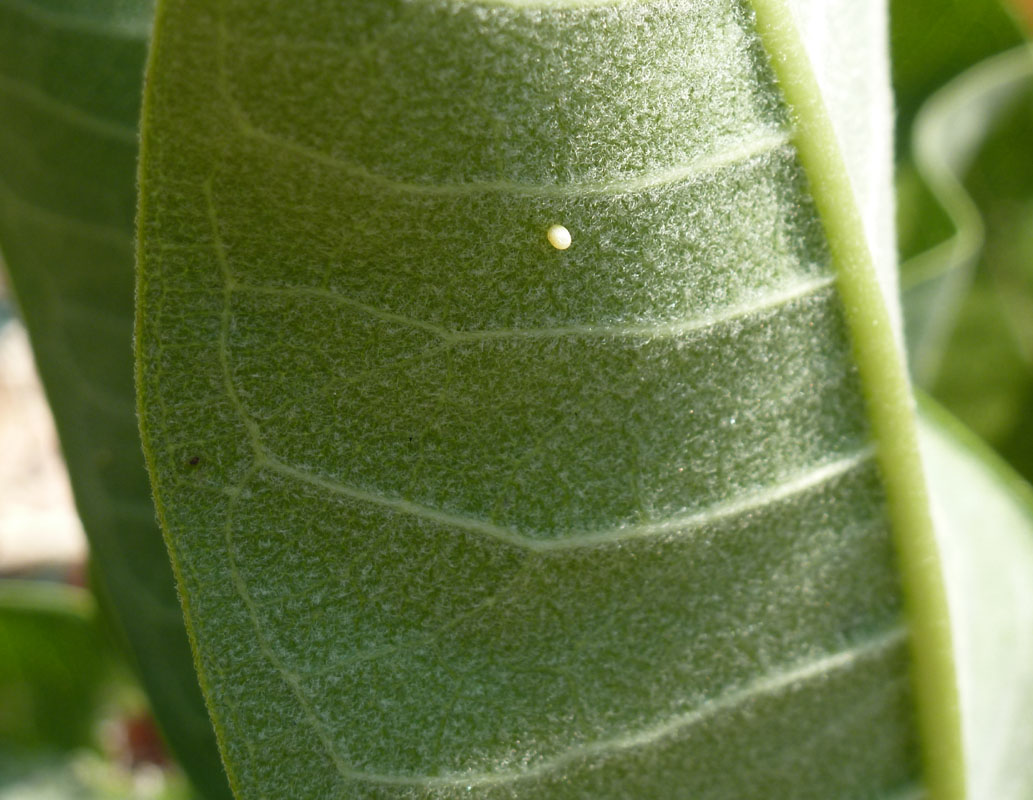
Around this time of year we hike up and down our road looking for monarch eggs and caterpillars on the milkweed that grows everywhere. We've gone a few times since the beginning of August, but haven't found any yet. Last week when we went looking we found a mystery egg on the backside of a milkweed leaf.

If you click the picture, you can see the tiny orange/pink egg a little more than half way down. This is not a monarch egg. Monarch eggs are yellow and conical in shape. There are only a few insects known to eat milkweed so i have no idea what this egg might be.


i am fairly certain that it's a butterfly egg.

This is how it looked on 8-12.

On 8-16 the egg is now translucent and you can clearly see something inside there.

What can it be??

Took this one today, 8-19. You can click the picture to see it better. There is definitely something in there! We are super excited to see what hatches out, and hope that we can identify it quickly so we can provide the proper food for it. i've been placing a variety of different common host foods in the aquarium with it, in case i miss it's hatching. The kids have been fascinated by the pictures, and trying to guess what it may be. Any ideas??

We are still waiting for the monarchs to arrive, as with everything this year they seem to be running a bit behind. We've only spotted one monarch butterfly so far this year. Last year we began finding the caterpillar at the end of July/beginging of August.

Our swallowtail butterfly should be emerging any day now. We've been checking our dill,fennel and carrots daily for new caterpillars, but haven't found any yet. The kids ask daily to look for monach eggs, so hopefully we will find some and our nature table will become a temporary home to some munchin' crunchin' caterpillars. :)


Tuesday, July 26, 2011

Raising caterpillars.

Earlier this week, my boy was out tending his garden and he came running in to show me the tiny caterpillar he had found.

This interesting little guy was only about 1/4" long. i'm quite amazed that my boy was able to spot it. He said it was just hanging out in the grass, near some Queen Anne's lace. We checked all around the Queen Anne's Lace but found no other caterpillars.

The caterpillar is a Black Swallowtail. This is the first instar. The instars are the stages between shedding skin. It will shed it's skin several times as it grows larger. Host plants for the Black swallowtail caterpillars are Queen Anne's lace, carrot, parsley, fennel and dill. We planted all of these this year, in hopes of attracting the Black swallowtails.

We moved our caterpillar to the carrots growing in the kids garden, where he would be a bit more protected. We were gone over the weekend, and missed getting pictures of the second instar. Here it is in the third instar, it is about 1" long. We will leave him to feed on the carrots until he is full grown and then we'll bring it inside so that we can watch it pupate and transform into a chrysalis.


While weeding the tomatoes, i noticed some rather large piles of bug poo on the leaves and around the base of one of my plants. i looked all over the plant and found the culprit.

This is a huge tomato hornworm. They are considered garden pests, because one caterpillar can do some serious damage to tomato plants. They eat non-stop and will consume not only the foliage but the green tomatoes as well. They are very easy to control. You just pick them off and move them away from your garden. In the past i have just thrown them to the chickens, who tend to follow me around when ever i am in the garden.

This time however, Sage freaked out and wanted to keep it as a pet. :)


It really is rather cool looking. i love the eye spots all along it's body. This guy is huge, he is around 4" long. Which means he is almost ready to pupate.

Unlike monarchs and swallowtails, the tomato horn worms pupate underground. So when we set up a habitat for him, we placed about 2 inches of soil in the bottom of our container. i planted a small tomato plant in the soil so it had something to munch on. We had lots of tomatoes coming up in our compost, so we won't miss this one. If you don't have any extra plants, you can just give him a few leaves or branches from your tomato plant. Replacing them as necessary.

Our hornworm spent the day munching on this tomato plant. We snapped the lid on the container overnight so he didn't wander away, but is the morning there was no sign of him. So we are assuming it has buried itself in the soil and pupated. In two weeks time, it should emerge as a 5 spotted Hawk Moth. If the caterpillar pupates at the end of summer, early fall it will overwinter in the ground.

We've been checking the milkweed near us, looking for monarch eggs but haven't found any yet. We just spotted our first monarch butterfly last week. So we should be seeing them soon. The county mowers have already come by and cut down about 75% of the milkweed that was growing near the road. It always makes me sad to see this. Milkweed is the only plant that monarch caterpillars will eat, so without it there will be no Monarch butterflies.

You can find a lot of good info on raising different butterflies and moths at this website.
When raising caterpillars it is very important to know what type of caterpillar you have, and what types of host plants the caterpillar will eat. Most caterpillars will only eat very specific host plants, and will die if not provided the correct foods.

Raising caterpillars is always fascinating and educational. It's something we enjoy every summer.


For those wondering, i'll be picking the winner of the ecomom giveaway later today!!! :)