Showing posts with label metamorphosis. Show all posts

Tuesday, August 23, 2016

Raising Monarchs

Every year we walk down the road to collect the monarch eggs and caterpillars before the county mowers mow down all the milkweed. 


The eggs are extremely tiny, but we've learned to spot them easily.  We remove the leaf with the egg and bring it home. We use to leave the eggs and only collect the caterpillars, but the eggs kept disappearing. i don't know where it's ants or something else that carries them off, but something seems to eat them. 


The newly hatched caterpillars are extremely tiny. After they hatch they eat what is let of their egg and then begin to munch on the milkweed.


As the caterpillar grows it sheds it's skin several times. These are called instars.  


When the caterpillar reaches it's final instar (#5) it stops eating and find a quiet place to rest. It spins some silk to create a sling for it's back legs, then it hangs upside down in a J position. It will shed it's skin a final time and underneath is the green chrysalis. 


In this photo you can see the green chrysalis and a newly eclosed Monarch.


When the Monarch is ready to emerge from it's chrysalis, it is visible inside. Sometimes it's gets very dark, almost back a day or two before the monarch is visable.


When the monarch first ecloses, it's wings are crumpled and it's abdomen is swollen. It's body contracts and pushes the fluid from the abdomen into the wings. The sit and let their wings dry for a few hours after they have eclosed. When the wings are dry they will begin to open and close them, signaling that they are ready to be released.


So far we have raised and released 4. i have another chrysalis, a caterpillar in it's final instar and a few newly hatched caterpillars. In the wild only 1 in 10 monarch caterpillars survive to adulthood, so raising them inside in a controlled environment is really important for their survival. Monarch populations have been declining for years because of the use of pesticides and loss of food source (milkweed). This year the monarch population has started to increase and i truly believe that is in part due to the efforts of all those planting milkweed and raising caterpillars inside. 

i truly feel that it is not only beneficial to caterpillars, but also to me and my children. Watching the process and knowing that you are helping to make a difference is a wonderful feeling. Seeing our monarchs fluttering around the herb garden, tasting the flowers and leaving tiny new eggs on our milkweed plants is so incredibly rewarding. 

The movie Flight of the Butterflies  is currently streaming on Netflix. It's a visually stunning documentary that follows the yearlong migration of the monarch butterfly from the volcanic forests of Mexico all the way to Canada. Definitely worth watching. 


Saturday, March 22, 2014

First Signs of Spring in the Blue Ridge 2014


This winter is really starting to feel like it will never end.  We've had a few nice days in between the snow, ice and polar vortex cold and i took advantage of them and went out looking for signs of spring.


Coltsfood is always one of the first wildflowers to come up.  It lines the sides of road in the spring along with dandelions, chicory, and touch-me-nots. These two little blossoms were just beginning to open. Once they fully open they are often mistaken for dandelions.


Spotting the first butterfly of spring is always a beautiful moment! This little Eastern comma seemed as curious of me as i was of her.  i was following her, but the way she kept circling around i think she may have been following me.


She would stop just a few feet away, and open and close her wings.  She sat perfectly until i got my picture and then she disappeared into the woods.


Catnip is coming up all over the garden! i've already transferred a couple into pot (yes, i actually got to play in the dirt!) and i'll have to dig the rest before the garden gets tilled. Catnip makes the most fabulous tea. It's in the mint family and is a natural sedative.


One of the biggest sign that spring is coming! My hens have started laying again! Most of my hens,are new and were not laying yet last summer.  None of my birds laid over the winter, so we've been waiting for the new birds to begin laying.  In just the last couple weeks they have begun to lay regularly. 


So this isn't really a sign of spring, it is more a sign that winter isn't done quite yet.  It's a black swallowtail chrysalis.  We raised the little black swallowtail caterpillar in our carrot bed, and watched it transform into this chrysalis. It has spent the winter snug inside, and is waiting for the perfect spring day to emerge. Hopefully we'll get to witness it, and i'll share a picture on my next signs of spring post. 


If we had no winter, the spring would not be so pleasant; if we did not sometimes taste of adversity, prosperity would not be so welcome.  ~Anne Bradstreet

Wednesday, October 9, 2013

Caterpillars.

Earlier this year i was feeling a bit disappointed by the lack of monarch butterflies. Every year we walk along our road and rescue the monarch caterpillars before the county mowers come by and cut down all the milkweed. We have been doing this for years and really enjoy it.  With all the change we have experienced this year i've been kind of clinging to our past routines, and raising monarchs in the fall is one that we were always look forward to.

We found it odd that we were not seeing any monarchs this summer. We walked up and down the road, and checked all of the milkweed but we didn't find any caterpillars or eggs. Then the last time we walked up the road all of the milkweed had been cut down, so we knew we would not be seeing any monarch caterpillars this year.  Milkweed is their only food source.


Despite the lack of monarch caterpillars, we've been finding lots of other neat caterpillars! Many that we have never seen before here. This is a Black and orange oak worm.  My daughter is fearless, she holds all of them..even the ones i'm to squeamish to touch.


This one is a Blinded Sphinx moth caterpillar. He's a strange looking fella in the photo, but he was really a pretty caterpillar. Bright green with some reddish pink speckles. 


We found 6 Black Swallowtail caterpillars munching on our carrots.


This is an Eastern Tiger Swallowtail Caterpillar.  We found him near the mailbox. Yellow Poplar is a food source for the Eastern Tiger Swallowtails and there is a large tree near the mailbox, so we think he fell out.  i wanted to keep him so we could watch him pupate, but it didn't seem to want to eat any of the fresh  leaves i'd given him. So we decided to just put him back in a poplar tree.


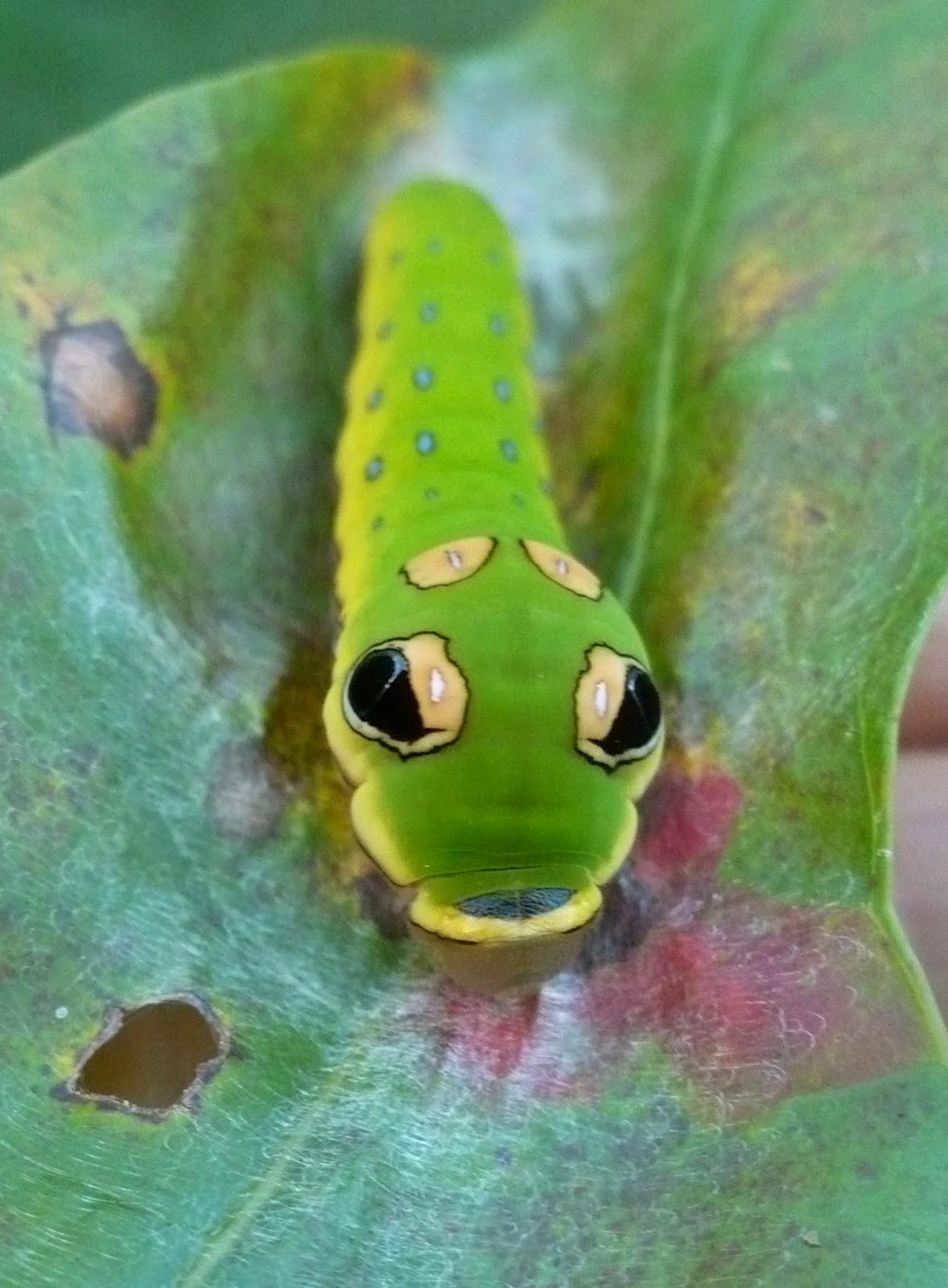
When i went to put the Eastern Tiger Swallowtail back on a poplar tree, i found this guy sitting quietly on a  Sassafrass tree. It's a Spicebush swallowtail caterpillar.  


This guy is the prettiest caterpillar i've seen in a while. Those giant eye spots are not really eyes at all. They are spots on his back that give him the appearance of a snake if a predator gets too close. He will tuck his head under, and puff up his back to show off those big 'eyes'.


The Spicebush caterpillar changes color right before he's going to pupate. So we collected the branch he was on, and are keeping it in our makeshift caterpillar habitat with the black swallowtail caterpillars. Hopefully we'll get to observe some pupating caterpillars soon. These caterpillars will stay in their chrysalis all winter, and they will not emerge as until spring.

i have always loved caterpillars and the process of metamorphosis, but never have i felt as connected as i do this year.  i am eagerly awaiting my time to pupate, and emerge next spring new and whole again.


 "We delight in the beauty of the butterfly, but rarely admit the changes it has gone through to achieve that beauty."- Maya Angelou


Friday, September 20, 2013

Raising Black Swallowtail Caterpillars.


One of our favorite activities each summer is to raise monarch caterpillars into butterflies. Near the end of July we begin taking weekly walks down the road checking the milkweed plants for monarch eggs and caterpillars.  This year we were surprised by the lack of monarchs. We have seen very few monarch butterflies in our flowerbeds. Walking down the road we realized there was very little milkweed this year, and no caterpillars. We checked several times and the last time we walked we found that the county mowers had come through and cut down all the milkweed. So we figured we would not be raising any caterpillars this year, the first time in probably 7 or 8 years.


Then one day last week, i was delighted to find a Black swallowtail caterpillar munching on my carrots. i plant dill and fennel every year because it is supposed to be a Black swallowtail favorite, but i haven't attracted any Black Swallowtails to it yet.  i was not expecting to find one in my carrots, and after looking around i found 5 others.  So i began to photograph them in the different stages. Black swallowtails go through several stages or instars, where they shed their skin and change their look a little.   This first one is about 1/2 " long. It is in the first Instar. 


After shedding it's skin the first time it enters the second instar. 


This one is about 1" long. He's a bit more colorful than the one before. 


During the Third Instar the caterpillarstarts getting quite a bit larger. He looks almost like a full sized BS caterpillar, except he is rather pale.The full grown caterpillars are green with the same markings.


This guy is full grown. He is resting, and will soon wander off to find a suitable place to form his chrysalis. i had originally left these guys on the carrot plants and have been checking them regularly. We really don't have a good place to keep them inside. Yesterday i noticed that a mole had started to nibble some of the carrots and the plants were wilting with the caterpillars still on them. So i knew i needed to move them.  i used to raise the monarchs in a 10 gallon aquarium. i also had a butterfly garden from Insect lore that i used for the emerging butterflies.  Since i nolonger have any of those items, i had to find something i had on hand.


This is a $1 popup clothing hamper that i picked up at the dollar tree a while ago. i have my washer set up in the shed, and i found that these cheap hampers work well for sorting clothing in there. They also work perfect for raising caterpillars! In the bottom, i placed a pot with soil and i have a glass jar with water that has fresh carrot, dill and queen anne's lace leaves/stalks in it. Once the caterpillars get large enough to start wandering, i'll add some sticks and leaves and things so it can find a good place to create a chrysalis.  i also used a mesh laundry bag (also from dollar tree) to go over the top to keep predators out, and caterpillars in. So far they seem quite happy, and are munching away on the fresh green plants. 


i may try to transplant some smaller carrots into the pot, but i'm not sure how well they' do. Next year, i'll be planting carrots, dill, parsley and fennel in this pot specifically for raising  BS caterpillars. :) These are some of their favorite food sources, and they don't eat enough to hurt the plants.

Although i'm really bummed that we are not raising monarch this year, i'm excited that we get to raise the black swallowtail.  

Monarch populations have been declining the last few years due to the lack of milkweed which is their only food source. Many people think of milkweed as an invasive weed, so they spray it or cut it down. If you want to help the monarchs you can plant milkweed in your yard and other flowers that attract butterflies such as tall phlox, gaillardia, butterfly weed, purple cone flower, tickseed etc. Native wildflowers are always best. You can also request free milkweed seeds from Livemonarch.com . 

i'll post updates on our caterpillars until they form they're chrysalis.  Because the temperatures are getting cooler, there is a good chance they will stay in their chrysalis all winter and will emerge in the spring. i'll be keeping them outside in the shed, so they experience the change in temperatures and do not get confused. We raised a swallowtail a few years back that stayed in his chrysalis all winter, and then emerged too early because of the warmth of the house. 

i'm going to take a walk later today and look for milkweed seed pods. Next year i'll make sure to plant a nice patch of milkweed that will not be in danger of getting mowed down. i may give some away some seeds on here as well if i find some! :) 

Friday, September 7, 2012

Monarch Twins update.

Update on our Monarch Twins.
They emerged very early in the morning, and were already drying their wings when i noticed them. i was pretty disappointed that we didn't get to see if they emerged at the exact same time.


They both were stretching and drying their wings, so i know they must have emerged very close to the same time.


i removed them from the container and gave them a bit more room to dry their wings and have a little snack on some fresh flowers before taking flight.


When they were ready we took them outside. Even though it was a bit overcast they immediately took flight. i was lucky to get this picture as they flew off the minute i opened the door.

Later that day while i was in the garden a monarch butterfly soared past. The way that it glided in circles, and seemed to dance in the air made me think perhaps it was one of the butterflies we had released. Monarchs fly as if they are love with life, they seem so carefree and graceful. They fly quite differently than other butterflies, and it truly looks like a dance. This one circled me a few times and lighted upon my arm for just a moment as if to say 'i remember you'.

Then it was off again, flying high above the trees and eventually disappearing. <3


The butterfly counts not months but moments, and has time enough. ~Rabindranath Tagore

Tuesday, August 28, 2012

Morning Magic.


Early yesterday morning, i walked outside to check on one of my gardens and witnessed this Red Spotted Purple emerging from it's chrysalis. i didn't have my camera with me, so i watched it emerge and then ran back to the house to get my camera, so i could get some pictures of it. We have raised lots of different caterpillars inside, Monarch, Painted lady, Black Swallowtail, Eastern tiger swallowtail, Great Spangled Fritillary etc. However, this was the first time i've ever seen a Red Spotted Purple's chrysalis and witnessed it emerging. i'm actually not even sure what the caterpillar looks like. It was really neat to watch!


While i was getting photos i spooked it a little, and it tried to fly off. It's wings were still wet and it was too heavy to fly.


So i gently lifted it up and brought it to a safe place so it could continue to dry its wings.


i'm not sure why it chose to form it's chrysalis on my garden fence. It seems kind out in the open. Typically they would pupate on a tee branch, and the chrysalis would be hidden among the leaves or camouflaged to look like a dead leaf. i'm wondering if the caterpillar had fallen out of a near by tree, and decided the fence was as good a place as any.


i placed the butterfly on this tree and it spread out it's wings to dry them and sun itself.

Such a magical and unexpected thing to witness. Watching a new butterfly emerge and eventually take flight is always a beautiful way to start the day.


Monday, August 27, 2012

Monarch Twins


These two caterpillar must have come from eggs laid on the same day. They both finished eating and came to the top of the container looking for a place to pupate at the same time.


They then began to spin their silk at the same time.


After they finished laying down the silk. They both turned around and hooked their back feet into the silk.


Then they both dropped down and formed their J's at the exact same time.


Early this morning they both formed their chrysalis at the exact same time. :) i'm now very eager to see if the butterflies emerge at the exact same time too. i've raised monarchs for several years now, and this is the first time i've had two act like identical twins.


Friday, August 17, 2012

Monarch hunting!

It's that time of year again when we start hunting for Monarch caterpillars. The county mower come through and mow down the milkweed along the sides of the roads. So we collect as many monarch eggs and caterpillars as we can find before they come. Monarch caterpillars eat only milkweed, and the butterfly population is+ declining because so much of the milkweed is removed/destroyed by people who think it's 'just' a weed.

We love to raise monarchs inside, watch them transform and release them after they emerge as butterflies.


The first Milkweed plants we came across were covered with they guys. These are Milkweed Tussock moth caterpillars. They also love to feed on milkweed and can commonly be found devouring the leaves.


i lifted up another leaf and found this little snail hanging upside down. Milkweed is poisonous and very few critters can eat it, so i don't think the snail was munching on it..although i'm really not sure what it was doing.


i checked another leaf and found what we had come looking for! That tiny white egg belongs to the Monarch butterfly. :) We brought the entire leaf back home with us and stood the end up in some water so that it didn't just dry up.


After a few days we spotted this tiny newly hatched caterpillar beginning to munch. It is about 1/8" long.


Munch, crunch. Munch, crunch. It's getting bigger!


each day i replace the milkweed with a few fresh leaves. Yesterday when i picked a leaf there was a tiny caterpillar on it. So i brought it home to raise too. This weekend i'll take the kids hiking up the road and we'll bring back any that we find. i'll be sure to show pictures of their transformation and release.


Tuesday, May 15, 2012

Raising Tadpoles.

A few weeks ago, we found a bunch of tadpoles in a puddle at Panther creek and brought home a few to raise.


Tadpoles are very easy to raise. We keep ours in the Insectlore Frog bog habitat we got a few years back. In the past, we have also them in a 10 gallon aquarium. i prefer the smaller frog bog though, it's easier to keep clean and unless you a have a ton of tadpoles it is plenty of room for them.


Make sure the container you use is very clean, and free from any soap residue.

In the wild, Tadpoles eat decomposing plant materials and insect larva found in the water. Some websites recommend feeding them fish flakes. However, we've had good luck feeding ours spinach leaves. We use fresh organic spinach from the garden. Wash it well, and place the leaves in a bit of boiling water to soften them up. Then rinse, cool and add them to your aquarium/habitat. The tadpoles will nibble away at these and produce a lot of poo that will need to be cleaned out every few days.


They grew really fast. The kids check them almost daily to report any changes. i usually get pictures of the whole process, but this time i totally missed getting of picture of the legs buds. When the kids checked on them one morning, we were surprised to see they had grown their legs!


By the next day, we had the feeling they were ready to be released.


So we took them behind our house to the creek, and let them go. They were so super tiny. i believe they may have been toads, rather than frogs because of the size. We released them in a wet/swampy area, where a spring was coming up from the ground. So there was a bit of water, but it wasn't fast moving like a stream or creek. We placed the little guys on some moss and dried leaves so they could decide where they wanted to go from there. It seemed like the perfect location for frogs or toads.

Just as we release the last one, and get the frog bog container cleaned out and put away, we came home with a new batch of tadpoles.

Just for fun, here is a really neat Tadpole Puppet printable you can print up from Scholastic to show how tadpoles transform into frogs through metamorphosis.

Here is another good printable coloring page that shows the life cycle of the frog. No matter how many times we experience watching the tadpoles transform, it just never gets old!